Abcd Cursive: A Practical Font for Handwriting Education
Understanding the D'Nealian Connection
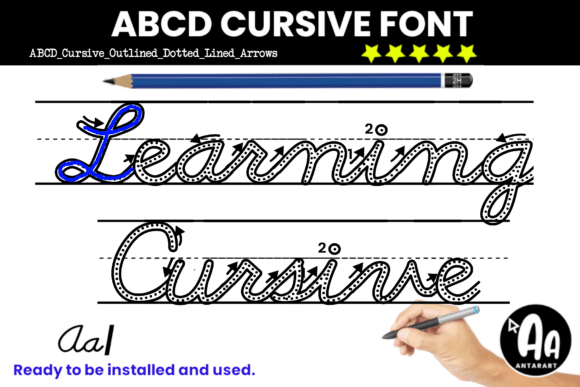
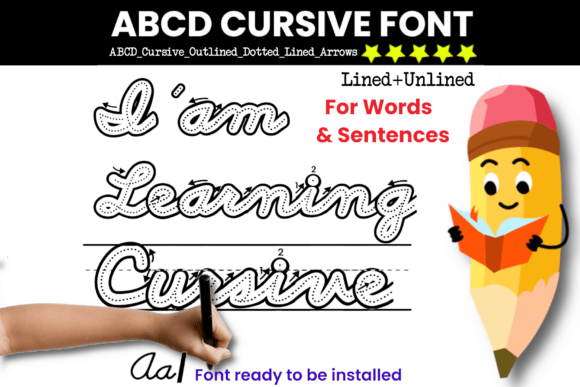
If you've ever struggled to create custom handwriting worksheets, you know the challenge: standard fonts don't connect properly, and most script typefaces are designed for aesthetics rather than education. Abcd Cursive solves this problem with a specific approach. It's a fully connected handwritten font based on the D'Nealian method, a widely recognized teaching system that uses a continuous stroke approach to cursive writing. The visual character of this font is functional rather than decorative. Letters flow into one another with consistent slant and simple, clean strokes. There's no unnecessary flourish—just clear, readable letterforms designed for tracing and imitation.
What makes Abcd Cursive practical is its dual offering. The fully connected version works well for words and sentences, while a spaced version (available separately) is better suited for individual letters and numbers. Both styles include uppercase and lowercase letters plus numerals 0–9. For anyone creating educational materials, this specificity matters. You're not forcing a general-purpose script font into an educational role; you're using a typeface built for that exact purpose.
Where This Font Actually Works Best
Abcd Cursive isn't a display font for headlines or a brand identity cornerstone. Its strength lies in educational and instructional contexts. Teachers, homeschoolers, tutors, and parents creating printable worksheets will find it immediately useful. Install it once, and you can generate custom tracing exercises in any word processor or design application—Microsoft Word, Google Docs, Canva, Adobe Illustrator, Affinity Publisher, or whatever you already use.
Consider a few realistic scenarios. A reading specialist might create differentiated worksheets for students at varying skill levels, using the same font but adjusting letter size and spacing. A homeschool parent could design practice pages that align with a specific curriculum. A tutoring center might produce branded materials with consistent typography. A craft blogger could share printable resources as lead magnets or digital products. In each case, Abcd Cursive functions as a design asset that streamlines production rather than a creative typeface that demands attention.
The font also has value in packaging design and editorial design for children's educational products—activity books, flashcard sets, learning kits. Its clean, connected style reads as approachable and instructional without looking amateurish. For social media graphics targeting educators or parents, it can reinforce a message about learning or literacy. But it's important to recognize its limits. This isn't a typeface for professional logo design, body copy on websites, or high-end brand identity work. It's a specialized tool, and its value comes from that specialization.
Font Pairing and Practical Considerations
When incorporating Abcd Cursive into a broader design, pairing matters. Because it's a handwritten font with educational intent, it works alongside clean sans serif fonts for instructions, headings, and labels. Think of pairing it with something like Open Sans, Lato, or Montserrat. A simple serif font can also provide contrast for parent-facing text or introductory paragraphs. Avoid pairing it with other script or handwritten typefaces—the visual conflict will undermine clarity.
Readability is straightforward here. The D'Nealian-based letterforms are designed for legibility at the sizes typical of handwriting practice—roughly 24pt to 48pt for tracing exercises. At very small sizes, the connecting strokes may become difficult to parse, which is true of most connected script typefaces. Test your worksheets by printing a sample page before distributing. Check that the letter connections are visible, that the slant feels consistent, and that the overall layout guides the eye naturally from one letter or word to the next.
Licensing is another practical consideration. Abcd Cursive is a commercial font, meaning you can use it in projects you sell—workbooks, digital downloads, printed materials for your classroom or business. Review the specific license terms to understand restrictions on distribution of the font file itself. Typically, you can create and sell end products (like printed worksheets or PDF downloads) but cannot redistribute the font files. This distinction matters if you're building a small business around educational printables.
Evaluating Fit for Your Projects
Before committing to any premium font, assess whether it actually serves your workflow. Ask yourself a few questions. Do you regularly create handwriting or tracing materials? Do you need connected cursive that follows a recognized teaching method? Will you use the font across multiple projects, making the investment worthwhile? If you answered yes to these, Abcd Cursive is a practical addition to your modern typography toolkit.
For designers and content creators who occasionally need educational elements, consider whether a single purchase covers your needs or if you'll want both the connected and spaced versions. The spaced version is particularly useful for letter recognition activities, flashcards, and individual character practice. Having both gives you flexibility to create a wider range of materials without workarounds.
Installation is standard—download the font files, install through your operating system's font manager, and the typeface becomes available across all applications. No special software required. This accessibility is part of its appeal. You don't need design expertise to use it effectively. A teacher with basic word processing skills can produce professional-looking worksheets, and a designer can integrate it into more complex layouts with confidence in its consistency and quality.
Ultimately, Abcd Cursive is a creative font with a narrow but well-defined purpose. It won't transform your web design or elevate your brand identity. But if your work involves teaching cursive handwriting—whether in a classroom, at home, or through digital products—it removes a significant production barrier. You get reliable, educationally grounded letterforms that install quickly, pair well with standard typefaces, and produce clean, functional worksheets. That's a practical solution to a specific problem, and sometimes that's exactly what you need.